
HUNTER CLASS
AAFTA RULE
Any seat without back or arm support may be used. The seat may not be used to support the rifle while shooting.
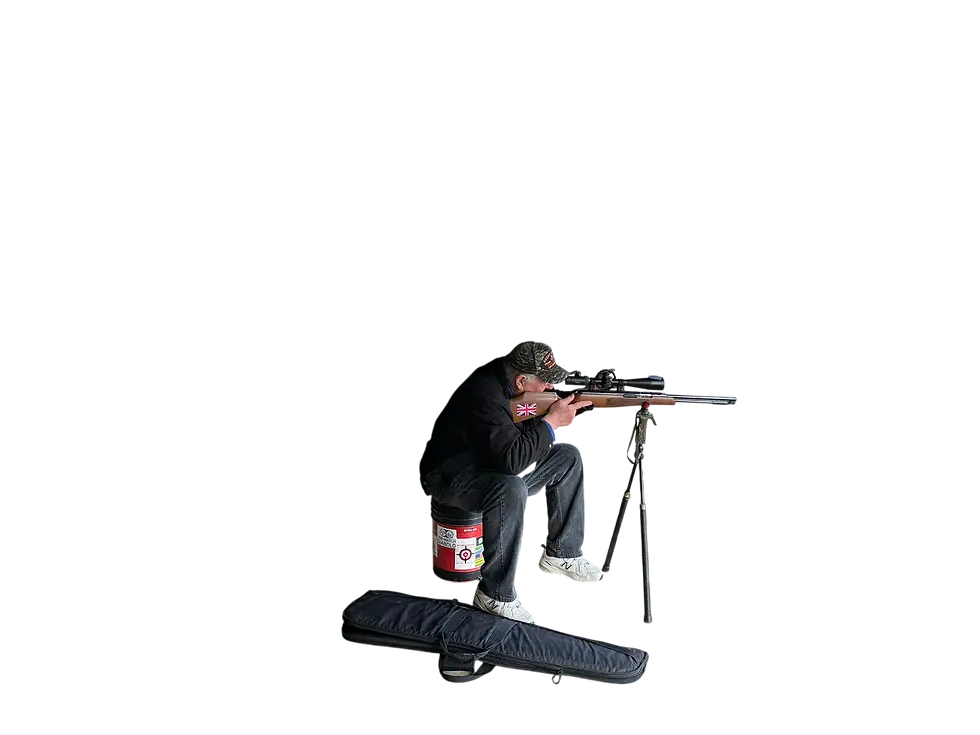
Five-gallon buckets and shooting stools are commonly used in Hunter Field Target. Seat height is not restricted, so choose something comfortable and stable. Many Hunter shooters use stools approximately 9–18 inches high. A five-gallon bucket is an inexpensive option for your first match, and new shooters are welcome to look at or try other shooters' setups before deciding what works best for them.
SEAT
Hunter Field Target is designed around practical air rifle equipment and a supported shooting position. Rifles may be PCP or piston powered and are limited to 20 ft-lb of muzzle energy. Any caliber may be used for the class, but .177 is typical.
Hunter shooters commonly use a stool along with an unattached bipod, monopod, or shooting sticks for support. The support rests on the ground and must release from the rifle when the rifle is lifted.
Scopes are limited to 16× magnification during the match. Shooters may adjust the scope's parallax to bring the target into focus and may use yardage markings to determine the target's distance.
Once the match begins, however, windage and elevation adjustments are not permitted. Shooters therefore use holdover or holdunder in the reticle to compensate for pellet trajectory at different distances.
AAFTA RULE
Monopods, shooting sticks or bipods may be used. They must rest on the ground or shooting pad, cannot be driven into the ground, and cannot be attached to the rifle.
Shooting sticks can be as simple as two ½-inch rods joined together, although most competitors use adjustable commercial sticks. Popular examples include BOG Adrenaline and Primos Trigger Stick models. If you're unsure what to buy, contact us before the match—we can usually help you try a setup before purchasing equipment.
STICKS
AAFTA RULE
Scopes are limited to 16× magnification during the match. Parallax may be adjusted to focus and range the target, and yardage markings may be used. Windage and elevation adjustments are not permitted during the match.
Hunter shooters typically use a scope with adjustable parallax that can focus throughout typical Field Target distances (10-55 yards). Side-focus scopes are especially convenient because shooters use the parallax adjustment to determine target distance. Once the distance is known, the shooter uses the reticle for holdover or holdunder rather than dialing the elevation turret.
is one example of a scope well suited to Hunter Field Target.
SCOPE
THE KNOCKDOWN TARGET
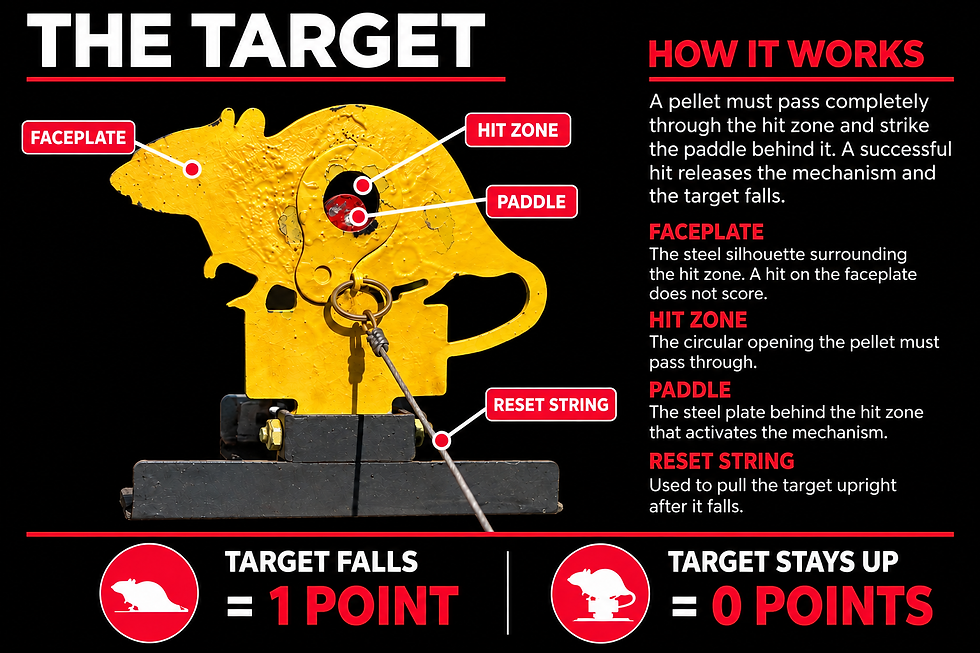
An AAFTA Field Target is a silhouette-style, fall-when-hit target that can be reset from the firing point. A circular hit zone in the faceplate exposes a paddle behind it. When a pellet passes through the hit zone and strikes the paddle with sufficient energy, the mechanism releases and the target falls. The shooter then uses the reset string to return the target to the upright position.
TARGET DISTANCE
The shooter takes position between the lane markers at the firing line. The muzzle must extend beyond the firing line while the trigger remains behind it.
AAFTA HIT ZONE DISTANCE LIMITS
HOW A FIELD TARGET LANE WORKS
01 -- SHOOTING POSITION
Field Targets are placed at unknown distances from 10 to 55 yards. Shooters determine the distance through their scope, typically by adjusting the parallax until the target appears sharply focused and reading the corresponding yardage marking.
AAFTA limits how far reduced hit zones may be placed. As the hit zone becomes smaller, its maximum allowable distance is reduced. This allows course designers to vary target size and distance while maintaining appropriate course difficulty.
10-55 YARDS
02 -- RANGE THE TARGET
The shooter identifies the correct target and determines its distance. Scope parallax may be used for ranging. No separate rangefinder is used.
RANGE → AIM → SHOOT → SCORE → RESET
03 -- TAKE THE SHOT
At a typical match, each target is engaged twice. The shooter follows the required position for the lane and fires one pellet per shot.
SMALLER HIT ZONES = SHORTER MAXIMUM DISTANCES
HIT ZONE
The hit zone is the circular opening in the target's faceplate. The pellet must pass through this opening and strike the paddle behind it to knock the target down. Hit-zone diameter and target distance work together to determine the difficulty of the shot.
AAFTA Grand Prix Rifle
Free Position
3/8" → 18.75 YD MAX
1/2" → 25 YD MAX
3/4" → 37.5 YD MAX
1" → 45 YD MAX
1½"+ → 55 YD MAX
04 -- SCORE & RESET
If the target falls, the shot scores one point. If it remains standing, the shot scores zero. After a successful hit, the target is reset with the attached string before the next shot.